You submitted your DC benchmarking report. Does that mean your building has satisfied its BEPS requirements?
Not necessarily.
Benchmarking reports how your building performs. BEPS may require you to improve that performance through an approved compliance pathway.
Here’s how the requirements differ, what to review in your benchmarking data, and what to do before the Cycle 1 deadlines.
What Is the Difference Between DC Benchmarking and BEPS?
Benchmarking measures and reports building performance. BEPS requires certain buildings to improve that performance.
Under the District’s energy benchmarking requirements, privately owned buildings with at least 10,000 square feet of gross floor area must track annual energy and water use in ENERGY STAR® Portfolio Manager® and report the previous calendar year’s results to the DC Department of Energy and Environment (DOEE), generally by May 1.
BEPS Cycle 1 applies to privately owned buildings with at least 50,000 square feet of gross floor area and District-owned buildings with at least 10,000 square feet. The cycle ends December 31, 2026. Buildings that did not meet the applicable standard when the cycle began must complete the energy performance requirements of their approved pathway by that date, unless DOEE has authorized a different schedule.
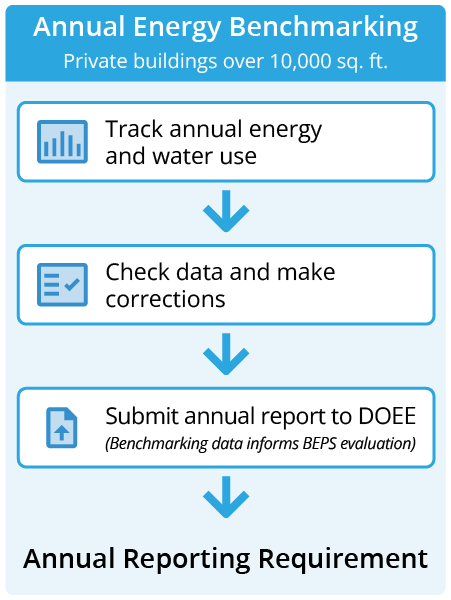
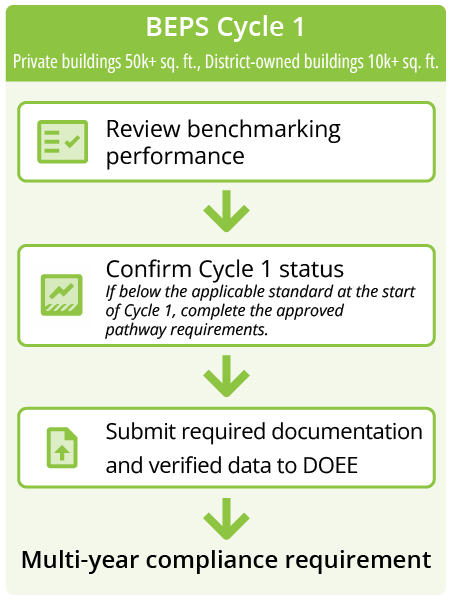
For example, a 30,000-square-foot private building currently has an annual benchmarking requirement but is not covered by BEPS Cycle 1. A 70,000-square-foot private building must benchmark annually and may also have Cycle 1 pathway requirements.
Some buildings must benchmark annually even though they are not covered by BEPS Cycle 1. A Cycle 1 building may also submit its annual benchmarking report and still have additional BEPS work to complete.
Why Does Accurate Benchmarking Matter for BEPS Compliance?
DOEE uses benchmarking data to evaluate building performance.
Meters, energy consumption, gross floor area and property-use details all affect the results reported through ENERGY STAR® Portfolio Manager®. Missing meters, incorrect space classifications, or outdated building information can change a building’s ENERGY STAR® score or energy use intensity (EUI).
Data discrepancies affect the accuracy of your annual report and how DOEE evaluates your building’s progress toward its BEPS target.
Before relying on your benchmarking results, confirm that:
- All energy and water meters are included
- Utility data is complete and current
- Gross floor area and property-use details are accurate
- Major changes to the building have been documented
- Unusual consumption patterns have been investigated
- Required third-party verification has been scheduled
Your goal is to make sure the report reflects how the building is operating.
What Does Your BEPS Compliance Pathway Require?
There is no single checklist that applies to every Cycle 1 building. Your approved compliance pathway determines the performance target, required actions, documentation, and reporting requirements for your property.
Some pathways are performance-based. These require the building to reach a defined energy-performance target by the end of the cycle. Other pathways are action-based and require the owner to complete and document specific improvements.
Buildings with an approved delay, exemption, or alternative compliance pathway may follow different requirements or schedules. Confirm the building’s status and pathway before deciding what work remains.
“The most common issue is data that looks complete in Portfolio Manager but has not been fully checked. Missing meters, incorrect floor area or property-use details, and gaps in utility data can change a building’s score or energy use intensity and affect its BEPS evaluation.”
– Chet Knaup, President, Spectrum Energy
What Should DC Building Owners Do Before the Cycle 1 Deadline?
Start by comparing what has already been completed with what the building’s approved pathway requires.
Cycle 1 ends on December 31, 2026. Buildings participating in a compliance pathway must complete the applicable energy-performance requirements by that date unless DOEE has authorized a different schedule.
For buildings following the Performance or Standard Target Pathway, the next major reporting deadline is May 3, 2027. Required submissions include the Completed Actions Report and the third-party-verified CY2026 District Benchmark Results and Compliance Report. The current DOEE Cycle 1 Guidebook provides requirements for each pathway.
Requirements vary by pathway: Buildings with an approved delay, exemption or alternative compliance pathway may follow different requirements or schedules.
For buildings in a compliance pathway, review these six items before Cycle 1 ends:
- Confirm the building’s Cycle 1 status.
- Confirm its DOEE-approved or assigned compliance pathway.
- Review Portfolio Manager data for completeness and accuracy.
- Compare current performance and progress with the pathway requirements.
- Identify any remaining energy improvements, required actions or data corrections.
- Confirm remaining documentation, third-party verification, and submission requirements.
The May 3, 2027 reporting deadline does not extend the December 31, 2026 performance deadline.
Reviewing these items now can uncover missing data, unfinished work or documentation gaps.
Not sure where your building stands? Talk with Spectrum’s energy consulting team to review your benchmarking data, pathway and remaining requirements.
This article provides a general overview and is not a substitute for current DOEE guidance. Building-specific requirements may vary based on property type, compliance pathway, approved delays or exemptions.